
Engineering White Paper: Structural Precision, Tolerances, and Design Mandates for CE-Certified AS/RS High-Bay Racking
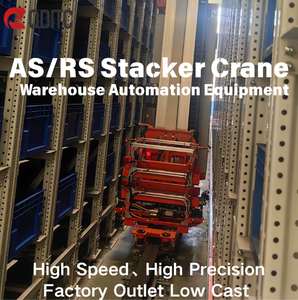
Automated Storage and Retrieval Systems (AS/RS) represent the apex of intralogistics engineering, where structural steel racking stops being passive warehouse shelving and transforms into dynamic, machine-toleranced machine frames. In modern fully automated logistics facilities, the racking superstructure routinely bears severe multi-axial dynamic excitations induced by high-speed Storage and Retrieval Machines (SRMs), multi-tier transfer shuttles, and autonomous mobile robots (AMRs). Operating at mast acceleration rates exceeding 2.0 m/s² and vertical lift velocities reaching up to 5.0 m/s at heights between 18 and 45 meters, any structural non-linearity, connection slippage, or floor settlement directly triggers optical misalignment, emergency braking sequences, or fatal machine collisions.
"Unlike conventional static selective racks engineered predominantly for gravimetric pallet support, an AS/RS high-bay rack operates as an integrated kinematic framework. Its structural engineering strictly demands compliance with European Norm EN 15512, FEM 9.831, FEM 10.2.02, and the European Machinery Directive 2006/42/EC to guarantee absolute serviceability and seismic resistance under cyclic fatigue."
1. Advanced Structural Mechanics: Steel Form Factors, Deflection Criteria, and FEM Norms
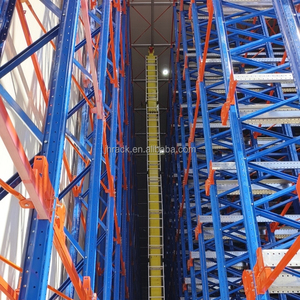
The manufacturing architecture of an industrial-grade AS/RS system hinges on proprietary cold-formed structural steel profiles engineered from hot-rolled micro-alloyed coils (predominantly S355MC, Q355B, and high-yield certified grades). The vertical upright sections feature continuous multi-bend omega or closed-box geometries, providing optimal torsional rigidity and maximum radius of gyration. When calculating upright buckling modes under Eurocode 3 (EN 1993-1-3), design engineers must calculate second-order (P-Delta) effects under asymmetric loading configurations where adjacent bays may be fully loaded while neighboring aisles remain empty.
Horizontal beam connections in CE-certified AS/RS factories reject conventional low-gauge friction clips. Instead, high-bay automated racking demands cold-stamped 5-lug or 6-lug heavy beam end connectors fabricated with integrated high-tensile locking bolts. This creates an engineered semi-rigid moment connection ($C_d$) with quantified rotational stiffness. Deflection limits under operational conditions are constrained to uncompromising thresholds: vertical beam deflection ($\delta$) cannot exceed $L/200$ to $L/300$ under maximum pallet unit loads (up to 2,000 kg), while horizontal mast guide rail sway must remain within $\pm 10$ mm across the entire vertical stroke to ensure SRM sensor targeting fidelity.
2. Stacker Crane Guide Rail Integration & Dynamic Impact Mitigation
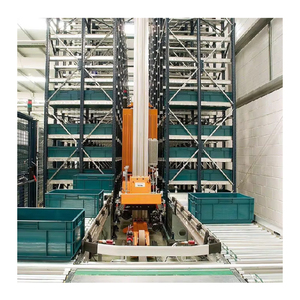
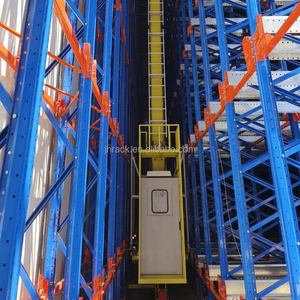
The floor-mounted running rail and the top guide rail of an AS/RS aisle are structural extensions of the racking frame. In standard free-standing and rack-supported building (clad-rack) architectures, horizontal dynamic braking loads from the stacker crane are transferred through the top ties into the overhead longitudinal bracing trusses. If the racking factory fails to control manufacturing straightness, twist, and camber to within $\pm 1.0$ mm per 10-meter span, the crane's guide rollers will suffer premature bearing degradation, severe chatter vibration, and acoustic resonance exceeding 85 dBA.
To eliminate these catastrophic failure modes, top-tier CE-certified factories employ in-line multi-axis automated CNC punching stations, high-frequency continuous roll-forming lines, and robotic welding cells that assemble guide bracketry with repeatable precision. Precision-shaved expansion joints and vibration-damping neoprene isolators are incorporated along continuous rail tracks to absorb thermal expansion cycles without distorting the geometric true plumb of the storage bays.
| System Architecture | Kinematic Handling Device | Max Storage Height | Payload / Unit (kg) | Aisle Clear Width | Throughput Rate | Applicable Industry |
|---|---|---|---|---|---|---|
| Unit-Load Pallet AS/RS | Single-Mast / Twin-Mast SRM | Up to 45 meters | 500 – 2,000 kg | 1,400 – 1,650 mm | 35 – 65 pallets/hr/crane | Pharma, FMCG, Cold Chains |
| Double-Deep AS/RS | Telescopic Fork SRM | Up to 36 meters | 800 – 1,500 kg | 1,500 – 1,750 mm | 25 – 45 pallets/hr/crane | Beverage, Dry Grocery, Raw Materials |
| 4-Way Radio Shuttle AS/RS | Carrier Cart + Vertical Lifter | Up to 24 meters | 300 – 1,500 kg | Zero Aisle (Dense Matrix) | 60 – 120 pallets/hr/system | Deep Freeze (-28°C), Distribution Hubs |
| Mini-Load AS/RS | High-Speed Tote SRM / Shuttle | Up to 22 meters | 25 – 100 kg | 900 – 1,150 mm | 120 – 300 cycles/hr/crane | E-Commerce, Electronics Spares, Auto Parts |
| AGV / AMR High-Bay Hybrid | Counterbalanced Autonomous Forklifts | Up to 14 meters | 1,000 – 1,600 kg | 2,100 – 2,800 mm | 20 – 35 pallets/hr/unit | Chemicals, Engineering Heavy Spares |
Engineering Anatomy of CE-Certified AS/RS Components
Continuous Roll-Formed Uprights
Fabricated using computerized multi-stage roll-forming lines. Micro-pitch adjustment slots (50mm/75mm) ensure absolute vertical alignment and minimum residual internal stresses.
Integrated Top-Tie Trusses
Overhead longitudinal and vertical K-bracing lattice engineered to absorb horizontal braking shear forces generated by dynamic stacker cranes, transferring loads directly into foundation slabs.
Seismic Anchor Baseplates
Heavy-duty precision-machined footplates anchored with multi-bolt dynamic chemical studs, calibrated against cyclic shear and pull-out uplift calculated under zone-specific seismic standards.
Automated Safety Interlocks
Laser-calibrated mechanical pallet backstops, run-through drop limiters, and photo-electric sensor brackets that prevent pallet drop incidents and verify correct load positioning in real time.
Global Procurement Trends: What EPC Contractors & Logistics Directors Must Know (2025–2030)
As enterprise procurement shifts toward lights-out automation, the evaluation criteria for selecting an AS/RS racking supplier have evolved far beyond steel price per metric ton. Global Engineering, Procurement, and Construction (EPC) firms and multinational enterprise logistics directors now assess suppliers against stringent Total Cost of Ownership (TCO) matrices and decarbonized lifecycle performance:
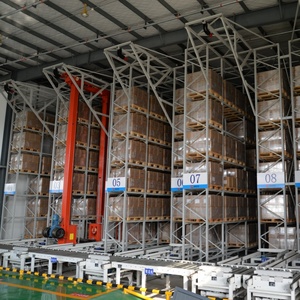
1. Shift Towards Rack-Supported Building (Clad-Rack) Architecture: Rising industrial real estate costs are driving the adoption of clad-rack buildings, where the high-bay racking serves as the load-bearing skeleton supporting roof structures and insulated wall sandwich panels. This architecture completely eliminates conventional building columns, maximizing cube volumetric efficiency up to 92%. However, this puts wind load, snow load, and seismic building code liabilities directly onto the racking manufacturer, requiring validated structural certifications (EN 1090-1 / CE Marking Execution Class EXC3).
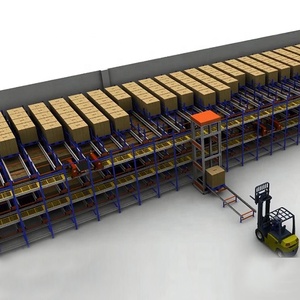
2. Deep Integration with 4D Pallet Shuttle Matrix Systems: While traditional single-aisle stacker cranes remain dominant for heavy through-pallet storage, high-throughput fulfillment hubs are adopting flexible 4-way shuttle technology. Shuttles navigate on high-precision precision-stamped rack running rails in both longitudinal and transverse axes. The racking structure must guarantee zero cumulative pitch error across 100 meters of continuous bay runs to prevent shuttle wheel climb and automated derailment.
3. Low-Carbon Steel & CBAM Compliance: International tenders across the European Union, Canada, and the United States increasingly require verified Environmental Product Declarations (EPDs). AS/RS manufacturers using certified low-emission electric arc furnace (EAF) steel and zero-VOC heavy-duty automated electrostatic powder coating systems are securing preferential procurement status over legacy coal-fired induction mills.
4. Digital Twin Modeling & Sensorized Structural Health Monitoring (SHM): Next-generation high-bay racking systems feature embedded fiber-optic strain gauges and tri-axial MEMS accelerometers at critical baseplate joints. These sensors relay real-time stress and cyclic fatigue data into the facility's SCADA and WCS platforms, enabling predictive maintenance alerts before structural micro-fissures or seismic displacement cause catastrophic line stoppages.
Total Cost of Ownership (TCO) & Civil Engineering Mandates for AS/RS Installations
Procuring an automated storage facility requires close coordination between structural rack designers and civil foundation contractors. A common point of project failure is overlooking slab tolerances: under DIN 18202 and British Concrete Society TR34 (Special Flatness / Superflat Floor Class DM1/FM1), floor deviations must not exceed 1.0 mm to 1.5 mm across a 3-meter straightedge. Failure to meet these criteria causes tall SRM masts to tilt beyond automated mast laser receptor limits, necessitating costly floor grinding or structural leveling grouting.
Furthermore, seismic design must account for spectral acceleration coefficients ($S_s, S_1$) specific to the installation site. In high-seismic zones (such as Mediterranean Europe, the Pacific Rim, or Western India), ductile moment-resisting frames with enlarged baseplate footprints and specialized beam-to-column hinge dissipators are legally mandated to prevent brittle structural collapse during emergency braking or regional earth movements.