Who are the top China Cantilever Racking System suppliers? This question matters as warehouses handle longer, heavier, and less uniform products. Steel coils, timber packs, pipes, and aluminum profiles need open-front storage. They also require controlled loading, stable arms, and reliable floor anchoring. A poorly specified rack can waste aisle space or create serious operational risks.
Industry data supports closer supplier evaluation. The MHI 2024 Annual Industry Report highlights continuing investment in warehouse automation, storage density, and resilient supply chains. Grand View Research also identifies warehouse expansion and industrial logistics as major drivers of global material-handling equipment demand. These trends do not automatically prove that every Chinese manufacturer is capable. They show why technical verification is necessary.
This guide examines leading China suppliers through practical criteria. These include manufacturing experience, structural design, load testing, surface treatment, export records, and after-sales support. It also considers whether a supplier can provide drawings, calculations, installation guidance, and traceable quality documents. Details matter. A strong cantilever arm should remain stable under its stated load, while base plates must suit the actual concrete floor. Certifications help, but they are not the whole answer.
No shortlist is perfect. Supplier websites may present polished projects without explaining failures, tolerances, or maintenance needs. Buyers should request recent references and inspect production evidence when possible. The best choice is not always the lowest quotation. It is the supplier that combines transparent engineering, consistent fabrication, and dependable communication from design through installation.
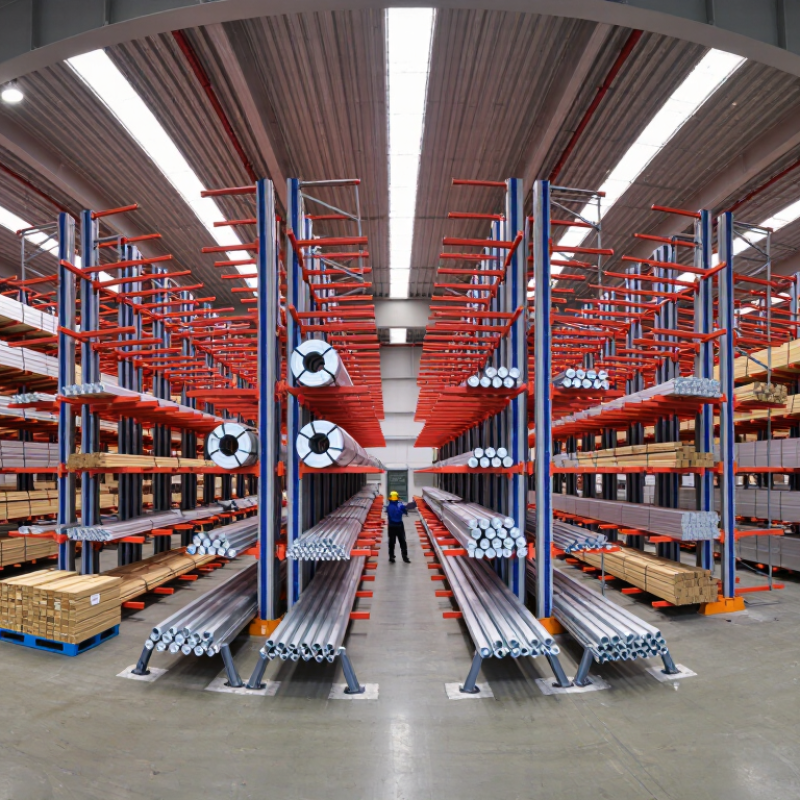
A China cantilever racking system is a steel storage structure for long, awkward loads. It stores pipes, timber, metal profiles, panels, and bundled materials without front columns blocking access. Upright frames carry horizontal arms, while a braced base transfers the load to the floor. Forklifts can approach from one side, or both sides in suitable layouts.
The system is adjustable. Arm levels can change as product lengths vary. Optional stops, decking, and protective guards improve control, but they do not replace engineering checks. The China Federation of Logistics and Purchasing reported that China’s total social logistics volume reached RMB 352.4 trillion in 2023, growing 5.2% year on year. That scale increases demand for denser, more flexible warehouse storage. Yet high volume does not justify selecting the cheapest rack.
A reliable supplier should provide load calculations, steel specifications, welding details, surface-treatment information, and installation guidance. MHI’s 2024 Annual Industry Report found that 91% of supply-chain leaders planned to increase technology investment. Cantilever racks are not fully automated, but their modular design can support clearer material flow and safer handling. I would inspect arm deflection, anchor quality, aisle width, and impact protection before comparing prices. Small omissions matter. The weak point may be the floor, not the rack. Supplier claims also need independent verification through drawings, test records, and site references.
Choosing a cantilever racking supplier in China requires more than comparing quoted prices. Start by checking engineering experience with steel profiles, welded joints, and load calculations. Ask for drawings showing column height, arm spacing, base dimensions, and stated capacity. A serious supplier should explain how loads change with timber, pipes, or long panels. Request recent project photos and contactable references. Details matter.
Evaluate factory capability through a video call or an in-person audit. Look for cutting, welding, surface treatment, and inspection areas. Ask how they control steel thickness, weld consistency, coating coverage, and dimensional tolerance. Request material certificates, load-test records, and a quality plan linked to each shipment. Independent testing can strengthen confidence, especially for heavy-duty systems. Certifications help, but they never replace production evidence.
Reliability also appears after the order. Confirm response times, spare-arm availability, installation guidance, and procedures for damaged parts. Clarify shipping terms, packaging, lead times, and how design changes are approved. A capable supplier admits limits instead of promising every specification. That answer may feel uncomfortable. It is often more trustworthy. I would inspect one sample assembly before approving a large order, because small misalignments can become expensive site problems. Early assumptions deserve a second look.
Leading China cantilever racking system suppliers are usually identified by engineering depth, not catalogue size. Strong suppliers design systems for steel bars, timber, pipes, and oversized panels. They calculate arm loads, column stability, floor anchoring, and seismic conditions. This matters because a loaded arm can behave differently from an empty display unit.
Industry selection should also consider production evidence. The China Federation of Logistics and Purchasing reported China’s social logistics value at about RMB 360 trillion in 2023. That scale increases demand for durable storage equipment and reliable delivery. Grand View Research also projected strong growth in global warehouse automation through 2030. Cantilever suppliers increasingly support barcode locations, forklift access, and semi-automated warehouses. However, automation does not replace sound structural calculations. A supplier with ISO-based quality processes, documented welding checks, load testing, and traceable steel certificates deserves closer review. Some online claims remain vague. That is a warning sign.
Tips: Request a signed load chart, installation drawings, material certificates, and recent project references. Check whether the supplier explains arm deflection and anchoring clearly. Ask for third-party testing where appropriate. Compare total cost, not only the steel price. A cheaper frame may require thicker reinforcement later. I have found that small drawing errors often create larger installation delays. Allow time for technical review.
Chinese cantilever racking suppliers compete strongly on cost, steel options, and production speed. MHI’s 2024 Annual Industry Report found that 55% of supply-chain leaders planned to increase technology investment. That pressure favors suppliers offering faster engineering changes and practical warehouse integration.
Quality differences still matter. Check steel certificates, welding procedures, load calculations, and coating thickness before comparing prices. A low quotation may exclude anchors, guards, delivery, or installation support. Request fatigue testing or third-party inspection for heavy timber, pipe, or metal profiles. ISO 9001 certification supports process control, but it does not prove every rack is safe. That distinction is often missed.
Service is less visible, but more important after delivery. Ask whether the supplier provides layout drawings, installation manuals, spare-arm availability, and response targets. The World Steel Association reported China produced about 1.005 billion tonnes of crude steel in 2024, showing its substantial manufacturing capacity. Capacity alone does not guarantee consistency. My practical concern is simple: remote communication can delay corrections, especially when measurements change. I have seen quotations look excellent until site conditions exposed missing details.
Tips:
Compare total delivered cost, not unit price. Ask for two recent export references. Require load signage, inspection records, and a written warranty. Keep one sample arm for dimensional checks before full production.
The right supplier is not always the one offering the lowest price. Look for proven experience with steel pipes, timber, profiles, or other long loads. Ask how many similar warehouse projects they have completed. Request photos, load calculations, and customer references. Real project evidence matters more than polished catalog pages.
Check the rack design carefully. The supplier should calculate column strength, arm capacity, base stability, and floor conditions. Ask for drawings that show load levels and safety factors. Material certificates and welding inspection records add confidence. Powder coating quality also matters in humid warehouses. A small surface defect can become a maintenance problem later.
Factory verification is useful. Review production equipment, quality procedures, packaging methods, and final inspection records. A reliable supplier should explain installation support, replacement parts, delivery terms, and response times. Confirm that the design can meet your local building and safety requirements. Do not accept vague compliance claims.
A cheap quote can hide weak steel or limited service. Be careful.
Suppliers may also make mistakes. Drawings can overlook forklift clearance or future expansion. Your team should review every dimension before production. A clear contract must define tolerances, testing, packaging, payment stages, and responsibility for defects. Good communication is valuable, but documented details protect both sides.
Look for engineering experience with steel bars, timber, pipes, and oversized panels. Ask for load calculations, anchoring details, and seismic considerations.
Loaded arms behave differently from empty display units. Calculations help confirm arm capacity, column stability, deflection, and floor anchoring.
Request signed load charts, installation drawings, material certificates, welding records, and recent project references. Clear paperwork matters.
Check steel certificates, welding procedures, coating thickness, and load testing. Quality certifications support process control, but they do not prove every rack is safe.
Not always. A low price may exclude anchors, safety guards, delivery, or installation support. Compare the complete delivered cost.
Request third-party inspections when appropriate. Keep one sample arm for dimensional checks before full production. Small errors can cause installation delays.
Useful support includes layout drawings, installation manuals, spare-arm availability, inspection records, and written response targets. Service becomes visible when problems appear.
No. Barcode locations, forklift access, and semi-automated systems improve operations. They cannot replace sound structural calculations and proper anchoring.
Confirm measurements in writing and review drawings before manufacturing. Ask about correction procedures when site conditions change. Remote communication can be slow.
Be careful with vague online claims, missing load charts, unclear material sources, and unusually low prices. If details remain unclear, pause and investigate.
A Cantilever Racking System is a flexible warehouse storage solution designed for long, bulky, or irregularly shaped materials such as pipes, timber, panels, and metal sections. This article explains how these systems work, including their vertical columns, horizontal arms, bases, and optional accessories. It also outlines the key factors to consider when evaluating suppliers in China, such as structural design, load capacity, material quality, manufacturing standards, customization capability, production experience, and quality control procedures.
The article compares Chinese suppliers in terms of product quality, pricing, delivery efficiency, technical support, installation guidance, and after-sales service. It emphasizes that the lowest quotation may not provide the best long-term value, especially if safety, durability, or communication is limited. To choose the right supplier, buyers should clearly define their storage requirements, request detailed specifications and quotations, verify production capabilities, review inspection processes, and confirm warranty and service terms before placing an order.